
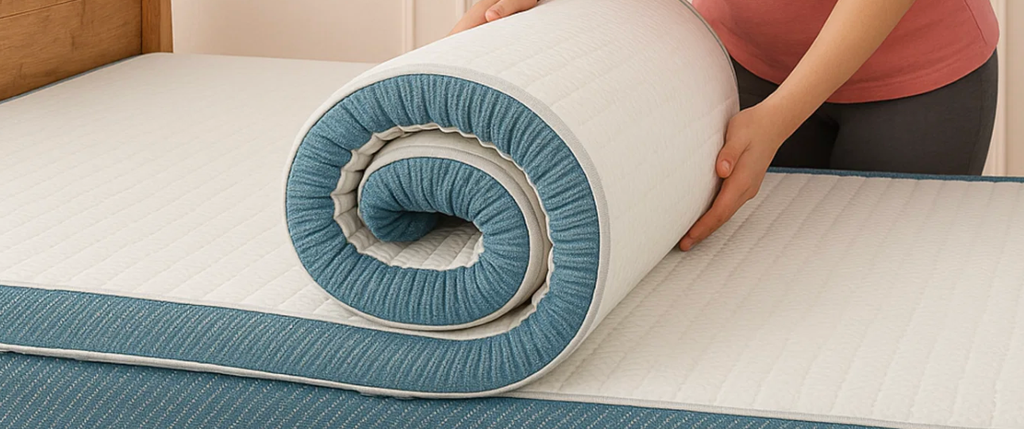
Sometimes the issue you’re experiencing with your bed has less to do with deep down support (which is what mattresses provide) and more to do with the comfort layer or top layer of your mattress. That top layer gives the mattress the surface feel or sensation you feel when you settle down to sleep for the night.
Instead of a full mattress replacement, a foam mattress topper layer could help create a plusher, sink-in, more cushioned feel depending on the density and type of the foam in the topper.
In other words, it can allow you to get a softer feel by modifying the present feel of your existing mattress. But it will do little on its own in the way of overall bed stability. That is where the mattress under the topper becomes the more dominant component.
A Mattress Topper Is an Additional Comfort Layer
A mattress topper sits on top of the mattress and adds a second layer between the sleeper and the sleep surface. To clarify, the additional support (mattress topper) isn’t designed to be part of your entire structure, but rather to sit on top of your mattress. The idea of this extra layer is to change how your existing bed feels. For example, if your current bed feels too firm for your needs, you could add a softer foam pad to bring in some softness.
Memory foam can hug the contours of our bodies, but a gentler foam can offer a more cuddly softness. But it’s a secondary function on top.
Start by Understanding the Existing Mattress
Do a mattress evaluation to understand what needs to change. Before you select a topper, think about what your present situation needs. Is your mattress fairly useful and great now, and you simply want additional padding for a softer surface?
An additional cushioning layer might be all you need. Does your existing bed mattress seem really soft?
Adding another deep, soft cushioning layer could make it feel excessively high-density. Additionally examine its present age as well as condition. If it is still reasonably level and not saggy or lopsided, your mattress provides a strong base.
This may help you avoid picking a bed topper by assessing how cushy and luxurious it feels on its own. Ultimately, your topper will only enhance the mattress beneath.
Surface Comfort and Mattress Support Are Different
It is useful to draw a line between the comfort of the surface and the construction that exists below the mattress topper. A mattress topper impacts heavily on initial comfort, due to its relatively thicker first impression to the body. Its level of soft, firmness, and depth will determine how readily this surface responds to pressure.
While this is true, the mattress topper does not erase the support and structure of the underlying mattress. As the topper compresses, then all that is the mattress is coming into the experience. It’s very possible that the same foam mattress topper sitting atop two distinctly different mattresses could yield disparate results altogether!
Memory Foam Changes the Surface in a Particular Way
Known for its conforming reaction, memory foam doesn’t push back as quickly as other comfort layers. As you lie on a mattress and your weight shifts, your body moulds and contours to the material without feeling it shift or push back immediately. As such, a memory foam layer can provide a more cushioning and encompassing feeling to a mattress surface, which might be enticing for someone looking for a noticeable level of contour.
It can also often offer an excellent layer of motion isolation that will help cushion the movements of another sleeper on the bed. The final feel of a topper will depend on what it lies atop. An enveloping memory foam topper over a firm mattress can feel different than that identical layer over a plush mattress, for example.
Soft Foam Creates a Different Experience
Not all foam toppers aim for that contoured ‘hug’ provided by memory foam. Instead, softer structures may emphasise a lush, soft surface, with some using different construction areas to distribute weight evenly around areas such as the shoulders, head, lower back, legs, and feet (known as 5 zone construction).
For instance, someone seeking only a softer mattress will favour a structure other than that constructed to resemble a ‘memory form’ responsive type, for as one has observed, the resulting texture/response is different and material selected according to the effect sought from the current one.
Thickness Determines How Much the Surface Changes
The more you thicken a topper, the greater an impact a new layer has on the feel of your bed. They come in one or two or even three-inch layers, based on the composition of the foam.
Because a more slender topper puts the person in bed closer to his or her mattress beneath, this creates fewer adjustments. Thickening the topper generates another layer of thicker foam, with consequently a larger impact.
If you’re looking for mild changes, you may not need the thickest available model. You’ve to look at the type of mattress existing, the type of foam used, and what sort of softness you desire.
Too Much Softness Is Not Always the Goal
You might assume softer beds = more comfort, but comfort is more complex than that. By adding a super soft topper on top of a soft bed, the degree of sink will increase further. Some like this while others will like having a more movable surface.
So instead, aiming for one which is compatible in terms of firmness is ideal. If the current setup is nearing one’s desired comfort, a small topper may just offer enough for adjustment and refinement. If a big difference is wanted, then a thicker one or one made from alternative materials may fit.
Thinking about the end result helps avoid the process just evolving into finding the softest!
The Mattress Condition Sets an Important Limit
While a topper can modify the comfort of the bed, people can overestimate the role additional cushioning should play. When the mattress suffers from heavy indentation, broken structural elements or extensive general wear and tear, a layer of foam laid on top will still find a support base riddled with problems. It will sink into those gaps and conform to them.
The only time a topper makes sense then is when the mattress retains most of its basic form and supportiveness, and what the sleep surface is truly offering is simply too hard or too soft to be comfortable. This difference may be subtle to most, but the objective is actually quite different. Before buying foam, examine your current mattress to determine if you’re dealing with a structural problem as well as comfort.
Zoned Foam Can Change How Weight Is Distributed
Foam in all topper sections doesn’t have to be the same. Certain topper styles create separate areas on the sleep surface to work in varied ways depending on the body parts they engage with. It’s possible to have a 3-zone memory foam that has a softer upper, firmer middle, and softer lower portion. Likewise, it is possible to construct a 5-zone, soft foam topper to separate how areas for head, shoulders, back, legs and feet perform.
It can adjust body weight and pressure on the surface. But zoning in relation to what comes in contact with your existing mattress needs consideration. Your mattress provides your mattress system with its backbone while topper layers add varying degrees of cushion along the topper surface.
Airflow Is Another Part of Comfort
The feeling that the topper provides isn’t based solely on softness and support alone, for example. Foam density is just a factor related to this kind of thing, and so different kinds of materials give different airflow around the sleeping surfaces. You may then find, for example, a Pincore mattress topper made using 10% gel memory Foam for increased airflow.
In the same way as you think of adding another layer on top, you might just have another foam choice; for example, many products could seem identical and yet feel very different throughout. To truly choose the best one; one has to check the mattress firmness, foam, thickness, and breathability and not one aspect at a time when making a comparison from feature to feature.
Motion Isolation May Matter for Shared Beds
When two people share a bed, movement on one side can sometimes be noticeable on the other.
Foam materials, particularly memory foam, can help isolate movement within the sleep surface. Motion isolation is therefore another characteristic worth considering when selecting a topper for a shared mattress.
However, the mattress underneath still plays a role. A topper can influence the way movement feels at the surface, but it does not completely change the construction of the underlying mattress.
Couples should therefore think about the complete bed rather than expecting a topper to independently determine how much movement is transferred.
Secure Fit Helps the Two Layers Work Together
A topper needs to remain properly positioned on the mattress if it is going to provide a consistent sleeping surface.
Anti-skid bottoms can increase friction between the two layers, while elastic bands can help secure the topper around the mattress corners. Correct dimensions are equally important.
If the topper continually shifts towards one side, its cushioning and any zoned features may no longer remain correctly positioned.
Before buying, measure the mattress and choose a corresponding topper size. Once installed, make sure the topper lies flat and that any securing bands are fitted evenly.
Consider the Combined Height of the Bed
Adding foam also increases the total depth of the sleeping surface.
A two or three-inch topper can make a noticeable difference to bed height. This may affect fitted sheets, mattress protectors and other bedding that previously fitted the mattress closely.
Sheets need enough pocket depth to accommodate the mattress and topper without continually pulling upwards at the corners.
This is a small practical consideration, but it can make everyday use much easier. A topper that works well from a comfort perspective should also integrate properly with the rest of the bedding.
Give the Combination Time to Be Evaluated
Choosing a topper based entirely on specifications can be difficult because comfort is highly individual.
The same thickness and material can feel different depending on the mattress underneath, body weight, sleeping position and personal preference. This is why the mattress and topper should be thought of as a combined surface.
Instead of asking whether a particular foam is universally comfortable, it is more useful to ask what that foam is intended to change about the current bed.
A clear comfort goal makes it easier to compare materials and thicknesses without assuming that one construction is automatically right for everyone.
Know When a Topper Is the Appropriate Solution
A topper makes the most sense when the underlying mattress remains usable and the main objective is changing surface comfort.
Someone may want additional cushioning, a more contouring feel, better motion isolation or simply a different surface response. These are areas where an additional foam layer can make a noticeable difference.
When the mattress itself is significantly damaged or structurally worn, the situation is different.
Understanding this boundary prevents a topper from being expected to solve a problem it was not designed to address.
Conclusion
A foam mattress topper should not be chosen as though it will function independently from the mattress underneath. The two layers work together to create the final sleeping surface, which means the firmness, condition and construction of the existing mattress all influence how the topper will ultimately feel.
Memory foam can introduce greater contouring and motion isolation, while softer foam constructions can provide a more plush surface. Thickness determines how strongly the topper changes the bed, but choosing the thickest or softest option is not automatically the best approach.
The most useful starting point is to identify what needs to change about the existing mattress. When the mattress remains structurally sound and the topper is selected to complement its characteristics, the combination can provide a more suitable balance of cushioning, responsiveness and overall comfort.