
Introduction
Healthcare app development has evolved significantly as patients, doctors, hospitals, and healthcare organizations increasingly rely on digital platforms. From telemedicine and electronic health records to remote patient monitoring and digital insurance services, healthcare applications have made medical services more accessible and convenient.
However, the growing amount of sensitive health information being handled digitally has also created new challenges. Data breaches, privacy concerns, fragmented healthcare systems, and limited interoperability continue to affect the healthcare industry.
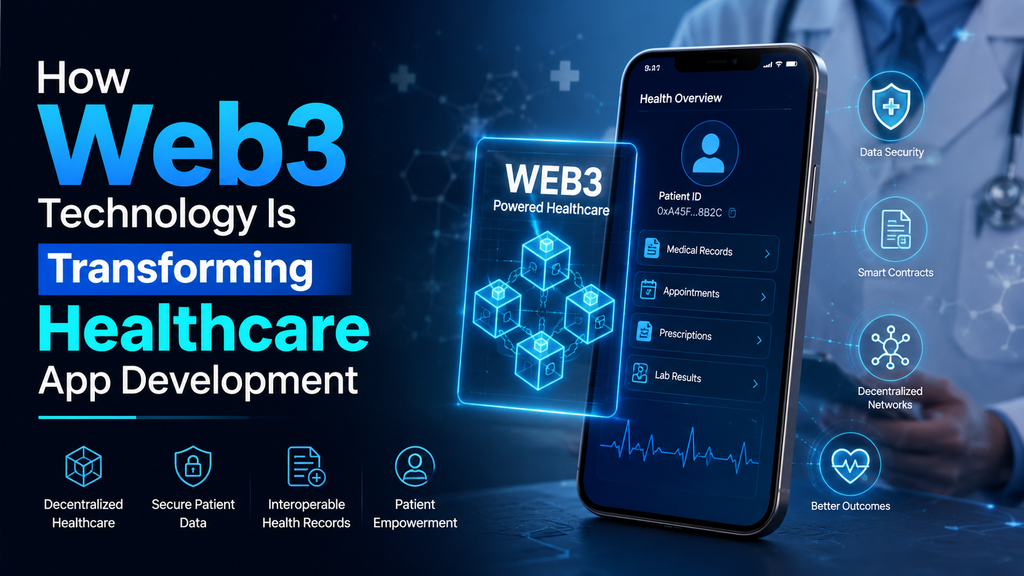
This is where Web3 technology is gaining attention. By combining blockchain, decentralized identity, smart contracts, cryptography, and secure data-sharing mechanisms, Web3 can introduce a more transparent and patient-centric approach to healthcare applications.
A healthcare app development company can use Web3 technologies to build applications that provide stronger data security, controlled information sharing, automated workflows, and greater patient control. While Web3 is not a solution to every healthcare challenge, it has the potential to reshape how healthcare data and digital services are managed.
What Is Web3 Technology in Healthcare?
Web3 represents a decentralized approach to digital applications. Unlike traditional applications that generally depend on centralized servers and databases, Web3 applications can use decentralized networks to distribute data, transactions, and verification processes.
In healthcare, this approach can help address several long-standing issues around data ownership, security, and interoperability.
For example, instead of giving a healthcare platform complete control over a patient’s information, a Web3-enabled application can use decentralized identity and permission-based systems to give patients more control over when and with whom their information is shared.
Blockchain can also create tamper-resistant records, while smart contracts can automate predefined processes such as insurance claims, payments, and consent management.
Why Healthcare App Development Needs Web3
Healthcare organizations manage highly sensitive information, including medical histories, prescriptions, diagnostic reports, insurance details, and personal identification data. Traditional centralized systems can become attractive targets for cybercriminals.
Healthcare organizations also frequently use different systems that do not communicate efficiently with one another. As a result, patients may need to repeatedly provide the same information when moving between providers.
Web3 can potentially address these challenges through:
- Decentralized data management
- Stronger identity verification
- Permission-based data sharing
- Tamper-resistant records
- Automated healthcare workflows
- Improved interoperability
- Transparent transactions
For businesses exploring these capabilities, working with an experienced web3 development company can help determine where decentralized technology can provide genuine value instead of adding unnecessary complexity.
How Web3 Is Transforming Healthcare App Development
1. Decentralized Patient Data Management
One of the biggest opportunities for Web3 in healthcare is improving how patient information is managed.
Traditional healthcare applications often store information within centralized databases. A decentralized approach can distribute verification and control across a blockchain network while keeping sensitive information appropriately protected.
Patients can potentially have greater control over access permissions. For example, a patient could authorize a doctor to access specific medical information and later revoke that permission when it is no longer required.
This model can create a more patient-centric approach to healthcare data management.
2. Enhanced Patient Data Security
Security is a major consideration in healthcare app development because medical information requires strong protection.
Blockchain can create records that are difficult to alter without authorization. Cryptographic techniques can also help secure transactions and identity verification.
However, sensitive medical data does not necessarily need to be stored directly on a public blockchain. A carefully designed healthcare application can use a hybrid architecture where sensitive information remains in secure systems while blockchain is used for verification, permissions, or audit trails.
This approach can help balance decentralization with privacy and regulatory requirements.
3. Patient-Controlled Digital Identity
Digital identity is another area where Web3 can influence healthcare applications.
Patients often need to verify their identity multiple times when interacting with hospitals, doctors, laboratories, pharmacies, and insurance providers. Decentralized identity solutions can provide a reusable digital identity that allows individuals to prove specific information without unnecessarily sharing additional personal details.
A healthcare app development company can integrate decentralized identity capabilities into applications to simplify authentication while maintaining greater control over user information.
4. Secure Health Data Sharing
Healthcare frequently requires information to move between multiple parties. A doctor may need laboratory results, a specialist may require previous medical records, and an insurance provider may need specific documentation.
Web3 can support permission-based data-sharing models where patients or authorized entities control access to specific information.
Blockchain-based records can also provide an auditable history of access and transactions. This can improve transparency while reducing unnecessary duplication of healthcare records.
5. Smart Contracts for Healthcare Automation
Smart contracts are self-executing programs that operate according to predefined conditions on a blockchain network.
In healthcare, they can potentially automate several repetitive processes. Insurance claims are one example. When predefined conditions are met, a smart contract could initiate the next step in the claims process without requiring extensive manual intervention.
Smart contracts may also be used for:
- Patient consent management
- Automated payments
- Insurance processing
- Healthcare agreements
- Credential verification
- Research participation workflows
Automation can reduce administrative work and allow healthcare professionals to focus more attention on patient care.
6. Improved Healthcare Interoperability
Healthcare data is often distributed across hospitals, clinics, pharmacies, laboratories, and insurance providers. When these systems cannot exchange information effectively, healthcare professionals may struggle to obtain a complete picture of a patient’s history.
Web3 can support interoperable ecosystems where different applications and organizations can verify and exchange information through standardized mechanisms.
The goal is not necessarily to put every healthcare record on one blockchain. Instead, Web3 can provide a trusted layer for identity, permissions, verification, and transactions between different systems.
7. Transparent Medical and Insurance Transactions
Fraud and administrative inefficiencies can create significant costs for healthcare organizations and insurers.
Blockchain’s transparent and traceable transaction model can help organizations verify certain healthcare-related activities and maintain reliable audit trails.
For example, insurance claims can be recorded and tracked through verifiable workflows. This can make suspicious changes or inconsistencies easier to identify and potentially reduce opportunities for fraudulent activity.
8. Pharmaceutical and Medical Supply Chain Tracking
Web3 can also extend beyond healthcare applications used directly by patients.
Pharmaceutical companies and healthcare organizations need to verify where medicines and medical products originate and how they move through the supply chain.
Blockchain can create a traceable record of product movement from manufacturers to distributors and healthcare providers. This can improve visibility and help organizations verify product authenticity.
For patients, the long-term benefit could include greater confidence that medicines have passed through legitimate supply chains.
9. Tokenization and Patient Engagement
Token-based systems can potentially support patient engagement programs. For instance, healthcare platforms could reward users for completing wellness activities, participating in approved programs, or maintaining specific health routines.
However, such systems need to be designed carefully. Healthcare organizations must consider privacy, regulatory requirements, ethical concerns, and the potential risks associated with financial incentives.
The focus should remain on improving patient engagement rather than unnecessarily introducing cryptocurrency into healthcare applications.
Key Benefits of Web3-Based Healthcare Apps
When implemented for the right use cases, Web3 can provide several advantages:
- Better data control: Patients can have more control over access to their information.
- Improved security: Cryptographic and blockchain-based mechanisms can strengthen data protection.
- Greater transparency: Transactions and access activities can become easier to verify.
- Better interoperability: Different healthcare systems can potentially communicate more effectively.
- Process automation: Smart contracts can reduce repetitive administrative tasks.
- Fraud reduction: Traceable records can make certain fraudulent activities more difficult.
- Improved patient experience: Digital identity and permission-based sharing can simplify healthcare interactions.
Real-World Use Cases of Web3 in Healthcare
Web3 technology can support a wide range of healthcare use cases, including:
- Electronic health record management
- Telemedicine platforms
- Decentralized patient identity
- Insurance claim processing
- Clinical research and data sharing
- Pharmaceutical supply chain tracking
- Medical credential verification
- Patient consent management
- Secure healthcare payments
- Remote patient monitoring ecosystems
These use cases demonstrate that Web3 can influence both patient-facing applications and the backend infrastructure supporting healthcare organizations.
Technologies Used to Build Web3 Healthcare Apps
A modern Web3 healthcare application can combine several technologies depending on its objectives.
Blockchain can provide transaction verification and tamper-resistant records. Smart contracts can automate predefined workflows. Decentralized identity can support secure authentication and identity management, while cryptography helps protect sensitive information.
A Web3 development company may also combine blockchain with cloud infrastructure, APIs, healthcare interoperability standards, mobile technologies, and existing hospital information systems.
The technology stack should always be selected according to the specific healthcare use case rather than adopting blockchain simply because it is a trending technology.
Challenges of Web3 Healthcare App Development
Despite its potential, Web3 healthcare app development comes with challenges.
Regulatory Compliance
Healthcare applications must comply with applicable privacy and data protection regulations. Blockchain architecture should therefore be designed with regulatory requirements in mind.
Scalability
Some blockchain networks may face limitations related to transaction speed and cost. Healthcare applications serving large user bases need scalable architectures.
Data Privacy
Healthcare information is highly sensitive. Developers need to carefully determine which information should be stored on-chain and which should remain within secure off-chain systems.
Integration With Existing Systems
Hospitals and healthcare organizations already use established software. Integrating Web3 components with existing systems can require significant technical planning.
User Adoption
Patients and healthcare professionals may not understand blockchain or Web3 concepts. Successful applications therefore need simple interfaces that hide unnecessary technical complexity.
What Should Businesses Consider Before Building a Web3 Healthcare App?
Businesses should begin by identifying a genuine problem that Web3 can solve. A clear use case should come before selecting a blockchain network or development architecture.
Security, scalability, interoperability, privacy, compliance, and user experience should all be considered during the planning stage.
Partnering with a specialized healthcare app development company can also help businesses combine healthcare-specific requirements with modern technologies. If blockchain or decentralized infrastructure is a major part of the project, collaboration with a web3 development company can provide additional expertise in blockchain architecture, smart contracts, and decentralized applications.
The Future of Web3 in Healthcare App Development
The future of Web3 in healthcare is likely to involve greater integration rather than complete replacement of existing healthcare systems.
Web3 could work alongside artificial intelligence, IoT devices, cloud platforms, and healthcare APIs to create connected digital ecosystems. AI could analyze healthcare data, IoT devices could collect real-time information, and Web3 technologies could help manage identity, permissions, verification, and data-sharing processes.
Patient-controlled digital identities, decentralized clinical research, secure health-data marketplaces, and blockchain-powered supply chains could become increasingly relevant as healthcare organizations explore new digital models.
Conclusion
Web3 technology is introducing new possibilities for healthcare app development by focusing on decentralization, transparency, data security, and patient control. From secure health-data sharing and digital identities to smart contracts and pharmaceutical tracking, its applications extend across multiple areas of healthcare.
However, successful Web3 healthcare applications require more than simply adding blockchain technology. Privacy, regulatory compliance, scalability, interoperability, security, and user experience must remain central to development decisions.
As healthcare continues its digital transformation, organizations that work with an experienced healthcare app development company and the right web3 development company can explore practical ways to use decentralized technologies while building secure, scalable, and patient-focused healthcare solutions.