
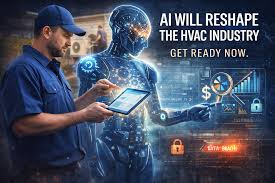
The heating, ventilation, and air conditioning industry has operated on the same fundamental logic for decades: something breaks, a technician fixes it, and the cycle repeats. Preventive maintenance schedules improved the situation marginally, but they still relied on static timetables rather than the actual condition of equipment. Today, that paradigm is collapsing under the weight of a far more capable alternative — artificial intelligence that doesn’t just respond to problems but anticipates them, learns from them, and continuously optimizes building environments in real time.
At the center of this transformation sits the cognitive ai platform — a class of technology that goes beyond simple automation to deliver machine reasoning, contextual understanding, and adaptive decision-making. For HVAC contractors, facility managers, and building owners, the implications are enormous. Operational costs shrink, tenant comfort improves, equipment lifespan extends, and energy consumption drops — sometimes by double-digit percentages. But understanding how this shift works, and why it matters now more than ever, requires looking beneath the surface.
The Problem With Traditional HVAC Management
Commercial and residential HVAC systems account for roughly 40% of a building’s total energy consumption. In the United States alone, heating and cooling costs exceed $100 billion annually across commercial real estate. Despite this, the vast majority of HVAC operations still depend on outdated control strategies: fixed schedules, manual thermostat adjustments, and reactive service calls when something goes wrong.
The inefficiency is staggering. A rooftop unit running at full capacity on a mild spring afternoon wastes energy. A chiller plant that doesn’t adjust to partial occupancy burns through electricity for empty floors. A compressor developing a refrigerant leak goes unnoticed for weeks, degrading performance long before anyone files a work order. These are not edge cases — they represent the daily reality of how most buildings operate.
Preventive maintenance helped, but only to a point. Changing filters every 90 days and inspecting coils twice a year follows a calendar, not the equipment’s actual condition. A system in a dusty industrial environment degrades faster than one in a clean office tower, yet both receive the same service interval. The result is either too much maintenance (wasting labor and parts) or too little (allowing failures to develop undetected).
Enter Cognitive AI: Beyond Rules-Based Automation
Early building automation systems introduced programmable logic controllers and basic scheduling. These were useful but fundamentally limited — they followed predetermined rules and had no capacity to learn or adapt. If the rule said “turn on the chiller at 7 AM,” the chiller turned on at 7 AM regardless of whether the outside temperature was 45°F or 95°F.
A cognitive ai platform represents a generational leap beyond this approach. Rather than executing fixed rules, cognitive AI ingests vast streams of data from sensors, weather feeds, occupancy detectors, utility rate schedules, and equipment performance logs. It then builds dynamic models of how a building actually behaves — not how an engineer assumed it would behave when the system was commissioned ten years ago.
The distinction matters because buildings are living systems. Occupancy patterns shift seasonally. Equipment degrades at uneven rates. Weather introduces constant variability. A cognitive system absorbs all of this complexity and adjusts its recommendations — or its direct control actions — continuously. It doesn’t just follow a playbook; it writes a new one every day based on what it has learned.
This is the core capability that separates cognitive AI from earlier generations of building technology: the ability to reason about context, weigh competing objectives (comfort vs. cost vs. equipment longevity), and improve its own performance over time without requiring manual reprogramming.
The Rise of the HVAC AI Agent
If the cognitive platform is the brain, then the hvac ai agent is the specialist that applies that intelligence to heating and cooling operations specifically. Think of it as a virtual technician that monitors every piece of equipment around the clock, understands normal operating parameters, detects deviations before they become failures, and recommends or executes corrective actions automatically.
An hvac ai agent operates across several critical functions simultaneously. First, it handles fault detection and diagnostics. Traditional building management systems might generate an alarm when a temperature setpoint is missed. An AI agent goes further — it identifies why the setpoint was missed. Was it a stuck damper? A failing compressor? A dirty coil reducing heat transfer? A refrigerant charge that’s dropped below optimal levels? The agent correlates multiple data points to pinpoint root causes, not just symptoms.
Second, it manages predictive maintenance. By analyzing vibration patterns, current draw, discharge temperatures, and dozens of other variables, the agent forecasts when a component is likely to fail — days or weeks before it actually does. This allows service teams to schedule repairs during convenient windows rather than scrambling for emergency calls that cost two to three times more and often leave tenants uncomfortable for hours.
Third, the agent optimizes energy consumption in real time. It learns the thermal characteristics of each zone, adjusts supply air temperatures based on actual demand rather than fixed setpoints, sequences equipment to minimize simultaneous peak loads, and takes advantage of utility demand-response programs that offer financial incentives for reducing consumption during grid stress events.
How a Cognitive AI Platform Processes HVAC Data
Understanding the technical workflow helps clarify why cognitive AI delivers results that simpler systems cannot.
Data ingestion is the foundation. A modern commercial building generates thousands of data points every minute — supply and return air temperatures, fan speeds, valve positions, power consumption, CO2 levels, humidity readings, and more. The cognitive ai platform aggregates these streams and normalizes them into a unified data model, regardless of whether the underlying equipment uses BACnet, Modbus, LonWorks, or proprietary protocols.
Next comes pattern recognition. Machine learning algorithms identify baseline behavior for each piece of equipment under various operating conditions. A rooftop unit serving an east-facing zone behaves differently in the morning than in the afternoon. A variable air volume box on the top floor has different thermal loads than one in the basement. The platform captures these nuances automatically, building a digital fingerprint for every asset.
Anomaly detection follows naturally. Once the platform knows what “normal” looks like for a specific unit under specific conditions, it can flag deviations with high precision. A compressor drawing 8% more current than expected for the current load and ambient temperature is an early warning sign — perhaps a bearing is starting to wear, or the condenser coil needs cleaning. These signals would be invisible to a traditional BMS but are obvious to a cognitive system trained on months or years of operational data.
Finally, the platform generates actionable intelligence. This might be a maintenance work order sent directly to a CMMS, an automated setpoint adjustment pushed to the BMS, or a prioritized recommendation displayed on a dashboard for a facilities management teamThe key is that the output is specific, contextualized, and timely — not a vague alert that something might be wrong somewhere.
Real-World Impact: Numbers That Matter
The business case for cognitive AI in HVAC is not theoretical. Organizations that have deployed these systems report measurable outcomes across every major performance metric.
Energy savings typically range from 15% to 30%, depending on the building’s starting condition and the sophistication of the existing controls. Much of this comes from eliminating simultaneous heating and cooling, optimizing start/stop times based on thermal mass and weather forecasts, and reducing fan and pump speeds during periods of low demand.
Maintenance costs drop by 20% to 40% as predictive analytics replace calendar-based schedules. Technicians spend less time on unnecessary inspections and more time on targeted repairs that prevent costly breakdowns. Emergency service calls — which carry premium labor rates and often require after-hours response — decrease significantly.
Equipment lifespan extends because systems operate within their optimal parameters more consistently. Short-cycling, a leading cause of compressor failure, is detected and corrected early. Excessive runtime caused by inefficient control strategies is eliminated. Components that would have failed in seven years may last ten or twelve instead, deferring substantial capital replacement costs.
Tenant satisfaction improves because comfort complaints decline. When an hvac ai agent detects and corrects a zone that’s drifting out of range before any occupant notices, the complaint never gets filed. For commercial property managers competing for tenants in a tight market, this translates directly into retention and lease renewal rates Building that kind of autonomous monitoring capability from the ground up requires specialized ai agent development services that can translate domain-specific HVAC logic into reliable, production-ready systems capable of operating continuously without human intervention.
Overcoming Adoption Barriers
Despite the compelling economics, adoption of cognitive AI in HVAC is not yet universal. Several barriers slow the transition, though each is shrinking.
Data infrastructure is the first hurdle. Many buildings lack sufficient sensor coverage to feed an AI system effectively. However, the cost of IoT sensors has fallen dramatically, and wireless sensor networks can be retrofitted into existing buildings without major construction or disruption.
Integration complexity is the second concern. Legacy BMS platforms were not designed for interoperability. A cognitive ai platform must bridge multiple protocols and vendor ecosystems, which requires middleware, API integrations, and sometimes custom drivers. The industry is moving toward open standards, but the transition remains uneven.
Workforce readiness is the third challenge. HVAC technicians trained in traditional mechanical systems may feel uncertain about AI-driven diagnostics. Successful deployments invest in training programs that position AI as a tool that enhances technician expertise rather than replacing it. The AI handles data analysis and pattern recognition at scale; the technician brings hands-on skills, judgment, and the ability to physically repair equipment.
Trust is perhaps the most subtle barrier. Building operators who have managed systems manually for years may be reluctant to cede control to an algorithm. Gradual adoption models — where the AI starts in advisory mode, making recommendations that humans approve before execution — help build confidence. Over time, as operators see the accuracy and consistency of the system’s recommendations, they typically grant broader autonomous authority.
The Future: Autonomous Buildings and Grid-Interactive Systems
The trajectory points toward increasingly autonomous building operations. Current cognitive AI platforms already handle many optimization decisions without human intervention. The next generation will integrate more deeply with utility grids, participating in real-time energy markets, adjusting consumption based on carbon intensity signals, and coordinating with on-site renewable generation and battery storage.
The concept of a grid-interactive efficient building — one that dynamically responds to grid conditions while maintaining occupant comfort — depends heavily on cognitive AI. A building that can pre-cool during off-peak hours, shed load during demand peaks, and dispatch stored energy when prices spike becomes a financial asset, not just a cost center.
Federated learning models will allow cognitive platforms to improve faster by aggregating anonymized insights across thousands of buildings without exposing sensitive operational data. A fault pattern discovered in one building becomes immediately useful for detecting the same fault in others, creating a network effect that accelerates the intelligence of every connected system.
Conclusion
The HVAC industry stands at an inflection point. The technology to move from reactive, schedule-driven operations to intelligent, adaptive building management is not only available — it is proving its value in real deployments every day. A cognitive ai platform provides the foundational intelligence, while a specialized hvac ai agent translates that intelligence into tangible outcomes: lower energy bills, fewer equipment failures, happier occupants, and buildings that actively contribute to sustainability goals.
For building owners and operators who have been watching from the sidelines, the risk calculus has shifted. The question is no longer whether cognitive AI will transform HVAC operations — it is whether you can afford to wait while competitors and peers capture the advantages first. The buildings of tomorrow are being optimized today, and the gap between early adopters and laggards will only widen as the technology continues to mature.