
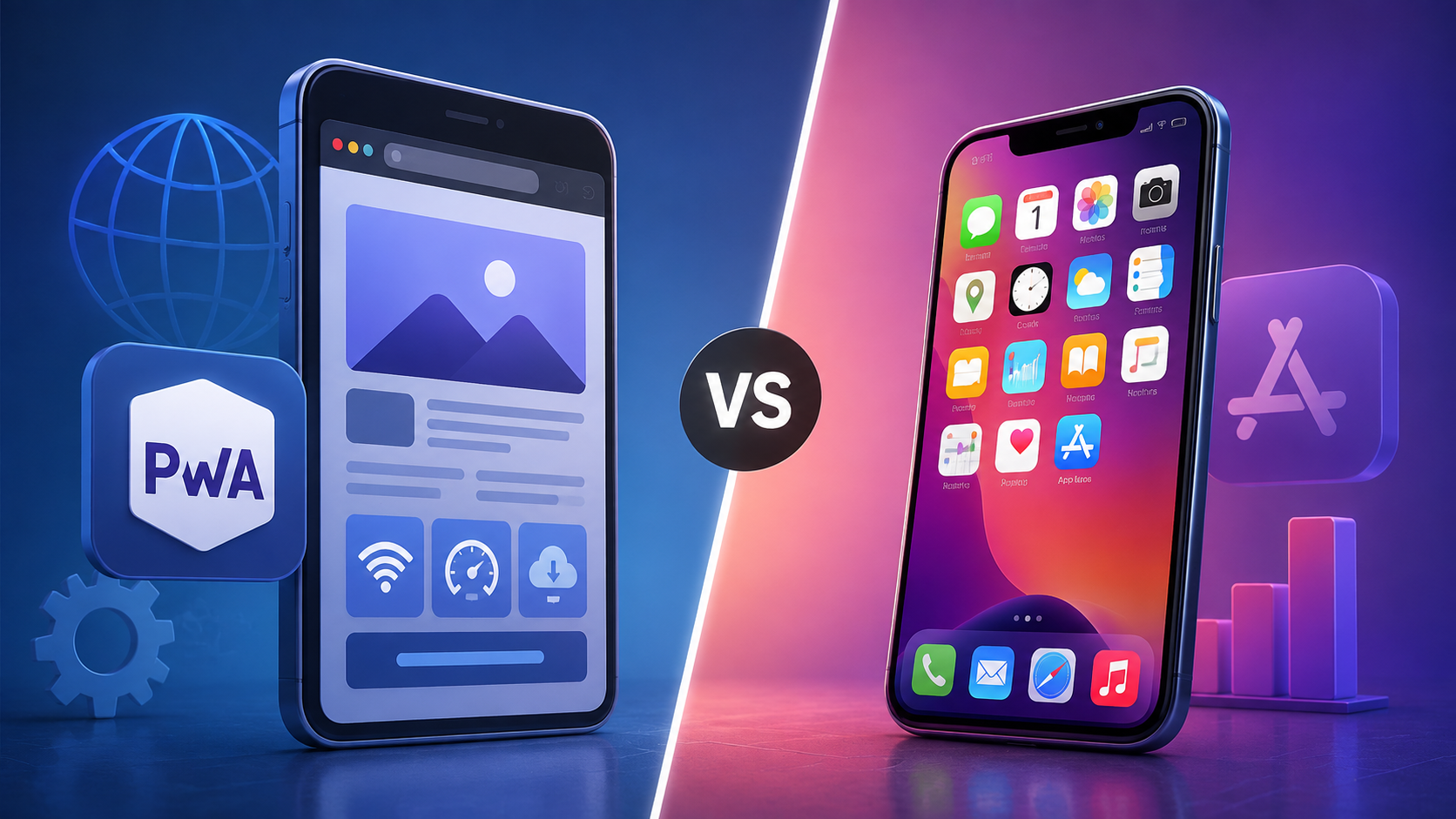
The mobile technology landscape has changed considerably over the past few years. Businesses and digital platforms are no longer automatically choosing native applications simply because they want an app-like experience. Progressive Web Apps (PWAs) have matured into a practical alternative, giving platforms a way to combine web accessibility with many characteristics traditionally associated with mobile applications.
The real question today is not whether PWAs or native apps are universally better. Instead, it is about which architecture delivers the right combination of performance, accessibility, development efficiency, and user experience for a particular platform.
Understanding the Difference Between PWAs and Native Apps
A Progressive Web App is essentially a web application enhanced with modern browser technologies. It can use a web app manifest, service workers, caching strategies, responsive interfaces, and installation features to create an experience that feels closer to a traditional application.
Native applications take a different route. They are developed specifically for operating systems such as Android or iOS and can make extensive use of platform-specific APIs. This approach gives developers greater control over hardware integration, system features, and application performance.
PWAs, meanwhile, offer an important advantage: users can reach them through a URL without first downloading software from an app store. Modern PWA implementations can also support installation, offline functionality, and push notifications, although capabilities can vary between browsers and operating systems.
Why Platforms Are Taking Another Look at PWAs
One of the biggest changes in mobile development is the growing importance of frictionless access. Every additional step between a user and a digital service can create an opportunity for abandonment.
A PWA removes much of that friction. A visitor can arrive through a search result, advertisement, social media link, referral, or direct URL and immediately interact with the service. If the experience provides sufficient value, the application can potentially be installed on the device for easier future access.
This model is particularly attractive for platforms where discovery through the web is important. Rather than requiring users to search an app marketplace, identify the correct application, download it, install it, and then open it, a PWA starts with the familiar web journey.
A technical example of this approach can be seen in a mobile-oriented web platform such as betboohizligiris.com, where a responsive, direct-access architecture illustrates why some services can prioritize a browser-based experience instead of requiring a separate native installation.
Performance: Native Still Has an Advantage
Performance remains one of the strongest arguments for native applications.
Native software is compiled and optimized for its target operating system, allowing developers to take advantage of platform-specific capabilities. For demanding applications involving advanced graphics, intensive animations, complex background processing, or extensive hardware interaction, native development can still provide important performance benefits.
Academic research comparing native and web applications has also found that native applications can use fewer hardware resources in certain scenarios, particularly regarding CPU, memory, energy consumption, and network traffic.
However, the performance gap is not always noticeable for ordinary digital services. A well-engineered PWA can load quickly, cache important resources, reduce unnecessary network requests, and provide smooth interactions. For content-driven platforms, account portals, marketplaces, media services, and other relatively lightweight experiences, browser-based technology can be more than capable.
The important distinction is therefore between technical maximum performance and performance that users actually need.
Installation and Accessibility
Native applications generally require users to visit an app marketplace or obtain an installation package. That distribution model provides advantages, including centralized updates, app-store visibility, and access to established mobile ecosystems.
PWAs approach distribution differently.
A user can access the platform directly through a browser. On compatible devices, the service may then be installed to the home screen and launched in a standalone-style environment.
This creates an interesting middle ground. The platform remains accessible like a website while offering several characteristics associated with applications.
For companies targeting users across multiple operating systems, that flexibility can significantly simplify the initial product strategy. One responsive web experience can serve desktop users, Android users, iOS users, and other browser-based audiences without requiring completely separate interfaces.
Development and Maintenance
Development efficiency is another major reason organizations consider PWAs.
A native strategy can require separate development considerations for different operating systems. Even when cross-platform frameworks are used, teams still need to account for platform-specific behavior, testing requirements, permissions, releases, and hardware capabilities.
A PWA can often be managed from a shared web technology stack. Changes can be deployed centrally, allowing users to receive the latest version without waiting for a traditional app-store update process.
This can be particularly valuable for rapidly evolving platforms. If the interface, navigation structure, pricing information, security controls, or other front-end components need frequent updates, web deployment provides a highly flexible environment.
That does not mean PWAs eliminate maintenance. Service workers, caching rules, browser compatibility, responsive design, security, and performance still require careful engineering. The advantage is that many of these responsibilities fit naturally within an established web development workflow.
SEO and Discoverability Change the Equation
Search visibility is another important difference between the two approaches.
A traditional native application is not primarily designed to be discovered through standard web search. Its visibility often depends on app-store optimization, brand recognition, advertising, or external referrals.
A web application can be part of a broader SEO strategy. Search engines can discover indexable web pages, while users can access those pages without installing an application first.
For platforms that depend heavily on organic discovery, this can make a PWA-style architecture particularly attractive. A company can build useful landing pages, educational resources, product information, and interactive experiences around the same web ecosystem.
The technical architecture therefore becomes part of the marketing strategy rather than simply a development decision.
Where Native Applications Still Make More Sense
Despite the progress of PWAs, native applications remain the better choice for many projects.
Applications that depend heavily on advanced camera capabilities, Bluetooth, health sensors, sophisticated background processes, intensive graphics, or other deep operating-system integrations may benefit from native development.
Gaming is another obvious example. When frame rates, graphics processing, low-level optimization, and demanding real-time interactions are central to the experience, native technology can offer greater control.
Native applications can also provide a highly refined platform-specific experience. Developers can design interfaces around established iOS or Android conventions and take advantage of operating-system features as soon as they become available.
The decision should therefore be based on requirements rather than fashion.
A Hybrid Strategy Is Becoming More Practical
The choice between PWA and native does not necessarily have to be permanent.
Some organizations can begin with a PWA to validate demand, understand user behavior, and establish a scalable web presence. If later research shows that users would benefit from deeper device integration, a native application can be introduced.
This approach reduces the pressure to make a huge technical commitment before product-market requirements are clear. It also allows teams to prioritize the features that create the greatest value first.
Browser-first entertainment platforms serve as a useful conceptual example of why this route remains attractive for services that prioritize immediate mobile accessibility and a streamlined user journey.
What Are Platforms Choosing Now?
There is no single winner in the PWA versus native debate.
Instead, platforms are becoming more selective. They are evaluating user expectations, technical requirements, development resources, device capabilities, search visibility, and long-term maintenance before deciding which model fits their product.
PWAs are increasingly compelling when reach, speed of deployment, web discoverability, and cross-platform accessibility are priorities. Native applications remain highly competitive when maximum performance, advanced hardware access, and deep operating-system integration are essential.
For some businesses, the strongest strategy may even be to maintain both. A fast web experience can attract and serve a broad audience, while a native application can provide additional functionality for users who want a deeper mobile experience.
Frequently Asked Questions
Are PWAs as fast as native applications?
Not in every situation. Native applications generally have an advantage for highly demanding workloads and deep system-level operations. However, a well-optimized PWA can deliver excellent performance for many everyday digital services.
Can a PWA be installed like an app?
On compatible browsers and devices, yes. PWAs can use web app manifests and browser installation mechanisms to provide a home-screen experience without following the traditional application-download process.
Are native apps better for SEO?
Native applications are not primarily built around conventional search-engine indexing. PWAs retain the advantages of the web, making their publicly accessible pages easier to incorporate into an SEO and content strategy.
Should every business build a PWA?
No. The right technology depends on the product. Businesses requiring intensive hardware integration or maximum native performance may be better served by native development.
Can a company use both a PWA and a native app?
Yes. A hybrid strategy can allow a company to use a web-based experience for broad accessibility while offering native applications to customers who require additional platform-specific functionality.
Conclusion
The PWA versus native debate is no longer about choosing between an old-fashioned website and a sophisticated application. Modern PWAs can provide installation, caching, offline capabilities, responsive interfaces, and app-like experiences while retaining the accessibility of the web.
Native development remains the strongest option for demanding performance and deep device integration, but it is no longer the automatic choice for every mobile platform.
The most effective decision starts with the user journey. If immediate access, cross-platform reach, search visibility, and efficient maintenance are central requirements, a PWA can be an intelligent solution. If advanced hardware capabilities and maximum system-level performance matter more, native development may be the better investment.
Ultimately, platforms are not simply choosing between two technologies. They are choosing the architecture that best supports their users, business model, and long-term growth. In that environment, the browser-first, mobile-friendly approach continues to appeal for its accessibility, flexibility, and alignment with the way modern users interact with digital platforms.