
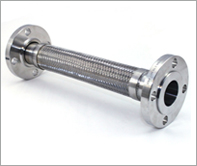
A quotation for a hose lands on the desk with one pressure figure printed across it. The buyer checks that figure against the line pressure, sees a healthy margin, and approves the order. Eight months later, the assembly fails on a steam line, and nobody can explain what went wrong. The number itself was accurate. The reading of it was not. A pressure rating on a stainless steel hose is never a single fixed value, and treating it as such puts sound assemblies into the wrong service.
Braid count sits right at the centre of this confusion. A single- and a double-braid assembly look almost identical once built and fitted. The difference only shows under load, and the pressure table for a stainless steel hose reflects that difference in ways buyers rarely expect. Here is why.
What the Braid on a Stainless Steel Hose Actually Does
The corrugated tube carries the media. The braid plays no part in containment at all. Its job is restraint. Internal pressure tries to stretch the corrugations lengthwise, rather like pulling a spring open. The braid grips the tube and holds it closed.
ISO 10380 puts a limit on that movement. Permanent elongation of a metal hose assembly after test pressure must stay within one per cent of its original length. The braid is what keeps it inside that limit.
- One braid layer restrains moderate working pressure.
- Two layers share the load and lift the working pressure.
- The corrugation profile, not the braid, sets flexibility and vacuum resistance.
Braid geometry matters too. For pressurised hose assemblies, the standard points to a braid angle between 40 and 50 degrees.
Why Bore Size Changes the Stainless Steel Hose Pressure Rating
Same braid, bigger bore, lower rating. The end area grows with the square of the diameter, so the axial force pushing against the braid climbs fast.
A 12 mm double-braid assembly and a 250 mm double-braid assembly are in entirely different pressure classes. Anyone quoting a single headline figure across a full-size range will get caught out. Sizes range from 6 mm to 350 mm, and the pressure column moves across the entire span.
Temperature Derating: The Number Most Buyers Skip
Catalogue pressure ratings apply at ambient temperature. Raise the temperature and the working pressure drops.
ISO 10380 publishes pressure derating factors for elevated temperatures, and BS 6501-1 carries its own table of temperature derating factors for hose assemblies. Stainless steel hoses can run up to 800°C. What they hold at that temperature is a fraction of the ambient figure.
Ask one question before ordering. What is the working pressure at your actual line temperature, not at 20°C?
Working Pressure or Burst Pressure? Read the Column Heading
Burst pressure looks generous on paper. It is also the wrong number to design around.
Metal hose assemblies commonly carry a 4:1 safety factor under dynamic conditions. Read a burst figure as a working figure, and you have quietly removed that margin.
Burst strength also depends on how the braid is attached at each end. The practical burst strength varies with the braid attachment method and has to be established by burst testing. Calculation alone will not settle it.
What a Second Braid Costs You
Double braid is not a free upgrade. Adding that layer changes the whole assembly.
- The hose stiffens and needs a wider bend radius.
- Weight increases, which affects supports and handling
- Price rises, sometimes beyond what the pressure gain justifies.
BS 6501-1 publishes minimum bend radii for hose assemblies, and those figures exist for a reason. Force a double-braid assembly into a single-braid bend, and fatigue life falls away. The most common specification error here is buying pressure capacity that nobody needed, while losing the flexibility the installation depended on.
Vacuum Service Ignores Braid Count
Braid resists pressure pushing outward. The vacuum pulls inward, and the braid contributes almost nothing against it.
Collapse resistance comes from the corrugation profile and wall thickness. A close-pitch, thick-walled annular corrugation copes well with vacuum. Ordering double braid to fix a collapse problem spends money and leaves the problem exactly where it was.
If your line sees vacuum, state it at the enquiry stage. It changes the hose choice, not the braid choice.
Reading a Braid Count for What It Is
Braid count answers one question and one question only: how much restraint holds the corrugations closed under pressure. It says nothing about the temperature you are running, the bore you have chosen, the fitting on the end, or whether the line ever pulls a vacuum. Buyers who read 1W or 2W as a grade rating end up trusting a figure that was never meant to carry that weight.
Send the enquiry with the full picture instead. Line temperature, bore, media, movement, vacuum, and the fitting you intend to use. The braid count then falls out of those answers rather than leading them, which is the order it was always meant to happen in.